Fieldnotes: Blogging on UNICEF's child survival work in the field

« Campus Initiative National Council members named | Main | A simple way to make bad water safe »

Sierra Leone: In honor of Fatima

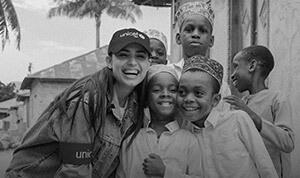
U.S. Fund for UNICEF President and CEO Caryl Stern recently visited Sierra Leone with Pampers "One Pack = One Vaccine" campaign spokesperson Salma Hayek and Pampers representatives, to witness the effect of tetanus on mothers and newborns, and the positive impact of the Pampers/UNICEF program. She sent this post from the field.

sierra-leone1.jpg
© UNICEF/ HQ98-0510/Pirozzi
SIERRA LEONE: An adolescent girl holds her baby in her lap near Freetown, the capital.

UNICEF's Dr. Yvonne Hardy and I sat on the floor with 19-year-old Memunata as we watched her tiny newborn daughter struggle for her life in a small crib next to her. Memunata had given birth to her first child exactly seven days prior. The delivery took place at home with the assistance of a traditional (but unskilled) birth attendant.

The labor went well by all accounts, and the baby girl screamed and cried on her arrival as anyone would expect. But within 48 hours, the baby was crying relentlessly and stopped nursing. Her jaw was clenched shut.

Memunata was frantic and found the birth attendant who told her to go to a local health facility. When she arrived at the clinic, the baby was diagnosed with tetanus and immediately referred to Ola During Children's Hospital, the only pediatric facility in Sierra Leone.

Yvonne went to the hospital in the early afternoon to meet with Memunata and her baby in advance of the rest of our group.

We arrived in time to learn that Memunata had just expressed her breast milk into a plastic cup, eager to feed her baby with a syringe. But the baby couldn't take it. We heard tiny gasps and watched as the baby convulsed, her back arched and her arms locked. She did that every so often, over the course of a few hours. The pain she was feeling was obvious. We all felt it.

tetanus1.jpg
© UNICEF/ HQ02-0277/Pirozzi
A card illustrates the risk factors and effects of tetanus, part of a flip chart used to advocate vaccinations against tetanus. The card shows (left-right, top-bottom): the target group – women of childbearing age; the rigid body and arched back that are symptoms of tetanus in a child; a woman who has cut herself in a field, possibly introducing into the wound tetanus spores found in soil; and common agricultural tools that can carry tetanus from the soil.

Only 10 percent of babies with tetanus survive, but the doctor who tended Memunata's daughter told us he was hopeful she would recover. Although there was no tetanus antibody serum for humans in all of the country (it's just too expensive), he had given her what they did have—horse antibody serum—along with valium to calm her spasms. The doctor wanted to put the baby in an oxygen tent too, but the hospital was completely out of oxygen.

Our UNICEF Team took turns going into the room with Memunata and her daughter. As I stood in the room during my turn, it suddenly took on an even more terrible air. I watched with horror as Memunata's tiny baby girl tried to draw in a breath and then seemed to just stop. As the color drained from her hands, turning her beautiful brown skin to a dull grey, we knew the worst had happened—we knew that she was gone.

In the moments of silence between coming to that realization on our own and then hearing Yvonne lean in and whisper, "I think the baby has passed," there were no appropriate words to say. What can one say?

Earlier, Memunata had told us that her baby was not yet named. Out of tradition, she was waiting for her eighth day before she would do so. She was going to call her Fatima in honor of Memunata's favorite sister.

Fatima never made it to her eighth day of life. She weighed less than five pounds and spent most of her life in agonizing pain.

We all bore witness to this, and it is fair to say the group was in shock. We had left home little more than 24 hours earlier knowing that it would be difficult to accept the juxtaposition between our daily life experience and what we would see when we got to Sierra Leone. But this… this was beyond comprehension. Witnessing the death of this child was horrific and infuriating. I wanted to break something. Horse antibodies? No oxygen?

Later, we gathered for dinner, and before our meal, we all stood in silent reflection in honor of Fatima. I yearned to be home with my own children—to hold them tight to me and say thanks for their safety. I felt guilty thinking those thoughts as I imagined the pain Memunata must be experiencing tonight.

sierra-leone2.jpg
© UNICEF/ HQ01-0129/LeMoyne
SIERRA LEONE: An aerial view shows Freetown, the capital, on the country's eastern coast, and mountains behind the city.

But, seeing these events unfold before my own eyes also underscores something that I feel from the depths of my soul, as a mother myself, and as a change leader in my professional work. I have often stated that the preventable death of even one child is completely unacceptable. Human civilization must not tolerate it, especially when we know how to prevent these deaths with simple, basic and affordable interventions.

Today, watching life fade from Fatima and then facing her mother Memunata, I knew how true that statement is. We cannot—we must not—I will not accept the preventable death of any child, and I will never consider under-five mortality statistics without thinking of Fatima.

I still believe wholeheartedly in UNICEF's commitment to do whatever it takes to save a child. I believe there's no question, we can and shall continue to do better. In addition to Fatima, some 25,000 children around the world will die needlessly from preventable causes today. I believe that number can be reduced to zero.

There's so much more to tell you about my visit to Sierra Leone. But most importantly—right here, right now—I just want to say, I believe in UNICEF and I believe in zero.

TrackBack URL for this entry: http://fieldnotes.unicefusa.org/mt/mt-tb.cgi/415

Comments (2)

Marcus Eagan:

President Stern this story is touching and your message is vital. I don't know if this action has already cross your or someone in your circle's mind, but there is a single-use (to prevent UNICEF's previous problem of cross-contamination) jet injector made by Imule that is much cheaper than traditional needles. If Tetanus vaccines were mass produced by Imule they would cost less than the estimated $0.53/per they cost now as small orders only. This is just an idea because I know you are, and surrounded by a group of powerful thinkers. Also I realize this doesn't address the mothers of child bearing age; consequently, I am still researching post-prophylactic treatments for tetanus and trying to come up with a cost effective way of distributing them.

But, with that in mind, very nice post. It looks like your trip to Sierra Leone was very important, particularly in making the magic number zero. It is so possible. Thank you for your great work, all of you.

Very touching story. Situations such as this make me only the more keen to channel my own professional skills and experience (journalism, communications) within this field.

Post a comment

(If you haven't left a comment here before, you may need to be approved by the site owner before your comment will appear. Until then, it won't appear on the entry. Thanks for waiting.)

Subscribe to our blog

About this blog

Welcome to Fieldnotes. Blogging gives us the ability to quickly report from the field, alert you to media coverage of interest, and share the success of UNICEF's lifesaving work around the globe.

We want to hear from you, so consider using the comment functionality to let us know what you think. Readers, please keep in mind that comments do not necessarily reflect official positions of UNICEF or the U.S. Fund for UNICEF. While we welcome multiple points of view here, we will review each comment prior to posting it and will not post comments that are off-topic or inappropriate for this public forum.

Frequent Contributors

Jen Banbury, Communication & Creative Services

Kristi Burnham, Community & Volunteer Partnerships

David Donaldson, Education

Mark Engman, Public Policy & Advocacy

Adam Fifield, Communication & Creative Services

Elizabeth Kiem, Interactive Marketing

Jenner Pascua, Interactive Marketing

Martin Rendón, Public Policy & Advocacy

Caryl M. Stern, President & CEO