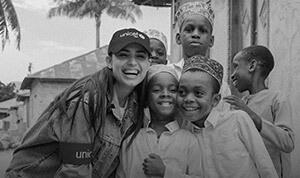
UNICEF Goodwill Ambassador Mia Farrow is in Lebanon to meet refugees from the conflict in Syria, as the needs and numbers of those fleeing continue to rise. She is blogging from the field, and you can follow her posts at http://unicef.tumblr.com/. She will also be participating in a Twitter chat tomorrow. During her visit, Ms. Farrow will travel to two locations close to the Syrian border, and will speak with both refugees and host families. In addition, she will visit UNICEF-supported child-friendly spaces, where children who have witnessed the horrors of the conflict receive psychosocial support and counseling.
At a press conference this morning, Mark Bowden, a UN humanitarian coordinator, said that famine conditions now exist in the Bakool and Lower Shabelle regions of Somalia. He warned: “If we don’t act now, famine will spread to all eight regions of southern Somalia within two months, due to poor harvests and infectious disease outbreaks… Every day of delay in assistance is literally a matter of life or death for children and their families in the famine-affected areas.”
Pakistan’s deadly floods have now affected over six million people, according to the latest estimates from the Provincial Authorities of Baluchistan, Khyber Pakhtunkhwa (KPK), and Punjab, in cooperation with the United Nations. “Things will probably get worse, before they start getting better,” said Martin Mogwanja, Humanitarian Coordinator in Pakistan. “We are working at full speed to respond to the most urgent needs of the affected populations.”
Dr. Muhammad Rafiq is Officer in Charge of the UNICEF Provincial Office in Khyber Pukhtoonkhawa, Pakistan. He send this report from the field.
The recent floods in Pakistan have been the worst I have ever seen in my 53 years. When I was young we heard from our elders that there were great floods in 1929, but we currently think that these are twice as bad. Nobody has any memory of a worse disaster.
For children this was truly terrifying. They were grabbed out of their beds by parents in the middle of the night and had to run to safe ground as water poured into their houses. The only warning they had was from local Mosques telling them to leave. They ran without their shoes and without their belongings.
With the death toll rising, outbreaks of waterborne disease are a serious threat. UNICEF and its partners have set up 9 medical camps in Swat and are providing medicines, water treatment tablets and jerry cans. The agency is also supporting local authorities in their efforts to provide clean drinking water.
To support UNICEF’s disaster relief efforts for the children of Pakistan, please donate online at www.unicefusa.org/pakistan – and share this information with your networks.
The foodies among us have been paying especially close attention to Bravo’s Top Chef Masters this season, because our favorite chef, UNICEF Ambassador Marcus Samuelsson has been slicing and dicing for the UNICEF Tap Project.
Alisa Aydin is part of the interactive team at the U.S. Fund for UNICEF.
Last week I was in Chicago for the U.S. Fund for UNICEF’s Annual Meeting. I’ve been hard-pressed since then to write a “wrap-up” post (we promised one in our Twitter coverage) that would capture the learning and the comaraderie that was shared.
I’ll start by recalling the intense emotion that bookended the event. First, there was the joy sparked by The Brown Sisters gospel performance — a rousing kick-off for all of us. But we left the meeting on a more somber note — reminded by CNN’s Soledad O’Brien and UNICEF’s Susan Bissell that among the hundreds of thousands of children affected by the Haiti earthquake are some 300,000 orphans who had already been abandoned or sold by their parents before the quake struck.
So we’re offering a double feature for this week’s Thursday video. Here’s a clip from the CNN documentary “Rescued.”
Now that you’ve raised your awareness, how about raising your spirits?
We also heard from UNICEF’s Representatives in Ethiopia, Swaziland and Ghana, who shared startling statistics and the tailored, country-specific approach that UNICEF takes to address the causes of preventable deaths in each unique environment.
On the eve of its 60th anniversary, we learned the true origins of the Trick-or-Treat for UNICEF campaign that has been and still is so often the first volunteer experience for children in the United States.
There were also sessions on HIV/AIDS and maternal and child health. A session on U.S. initiatives addressed the range of domestic programs through which our education, advocacy and fundraising is effected.
It was a busy, eventful, and too-short gathering. It was also a great way to show our partners and supporters the strides we are making together to improve child survival and to motivate us all to keep up the pace to improve the lives we have worked to save.
We’ll share news on the current situation for children as we receive it here on Fieldnotes. In the meantime, if you would like to make a donation to support emergency relief for children caught in disasters around the world, you can do so online here.
Thirty years ago, only one out of five children were immunized against killer diseases like measles and polio. Throughout the developing world, millions of children were dying of illnesses that had all but disappeared in the world’s wealthier countries. Since then, a near miracle has taken place. Now, four out of five children are protected by vaccines. Polio is on the verge of elimination. Measles and tetanus deaths have been reduced dramatically. This miracle did not happen by itself.
Welcome to Fieldnotes. Blogging gives us the ability to quickly report from the field, alert you to media coverage of interest, and share the success of UNICEF's lifesaving work around the globe.
We want to hear from you, so consider using the comment functionality to let us know what you think. Readers, please keep in mind that comments do not necessarily reflect official positions of UNICEF or the U.S. Fund for UNICEF. While we welcome multiple points of view here, we will review each comment prior to posting it and will not post comments that are off-topic or inappropriate for this public forum.