On July 9 the U.S. Fund for UNICEF staff and UNICEF Ambassador, Clay Aiken attended Key Club's International 67th Annual Convention in Memphis, Tennessee. Key Club and the U.S. Fund for UNICEF have had a long standing partnership, raising funds for those affected by HIV/AIDS in Kenya and Swaziland and more recently, pledging $1 million to assist the youth of Uruguay.
|
| © U.S. Fund for UNICEF |
| Key Club International President, Abigail McKamey (center) presented a check to UNICEF Ambassador Clay Aiken and Kristi Burnham (left), Director of Volunteer and Community Partnerships, U.S. Fund for UNICEF, for funds raised on behalf of Operation Uruguay. |
Donations collected through the Trick-or-Treat for UNICEF campaign will directly support UNICEF-Uruguay's health and education programs. To learn more about Key Club and U.S. Fund for UNICEF's partnership, visit www.unicefusa.org/keyclub.
UNICEF Ambassador Clay Aiken originally wrote this blog post for The Huffington Post on December 29, 2009. Please consider making a donation today to support UNICEF's lifesaving work for children in Somalia.
|
| © U.S. Fund for UNICEF |
| Clay Aiken on a recent field visit to Somolia. |
This past November, while we celebrated the 20th anniversary of the signing of the Convention on the Rights of the Child, a grim milestone was reached in the east African nation of Somalia. The conflict and instability which has characterized that nation for the past 20 years has produced a generation in its central southern province that has never known peace.
In this season of peace and goodwill, this jarring reality should spur us to action so that future generations are not lost.
The mere mention of Somalia conjures in the mind of everyday Americans a place where lawlessness reigns. Indeed, the perception is that no other country has done more to place the issue of maritime piracy at the forefront of our minds and within our headlines.
While this may be true...it's certainly not the whole story.
Last year, in my role as UNICEF Ambassador, I spent five days in northwest Somalia. There's no question that years of civil war and a defunct central government has left much of this nation dangerously unstable. In fact, half the population of Somalia remains internally displaced and in a state of humanitarian emergency.
This tragic reality affects an estimated 3.6 million people, half of whom are children. Over 1.5 million are displaced as a result of conflict, largely between Islamic extremists and government forces. Not only is this population burdened by violence and instability, but also extreme poverty and recurrent food shortages.
There are, however, glimmers of hope. For one, the Somali Transitional Federal Government (TFG) has made overtures to place the well-being of children on its emerging social service agenda.
For the final 12 days of 2008, UNICEF celebrity Ambassadors and supporters are posting daily blog entries about the impact UNICEF Inspired Gifts are having on children around the world.
Every child has a right to an education.
Often times in emergency situations, it becomes harder than ever for children to go to school. Natural disasters and conflict often destroy schools and supplies, leaving children without a place or the tools to learn.
UNICEF works hard to make sure that children receive an education no matter what the obstacle. For just $186 you can send children in need a School-in-a-Box kit, offering an opportunity to an education that otherwise wouldn’t exist. Just think—one kit provides a temporary school for up to 80 children at a time in an emergency!
![]() |
As you count down the twelve days this holiday season, think of these children who have nothing but hope—don’t turn your back on a child’s right to education.
I am Clay Aiken and I believe in zero.
25,000 young children die every day from preventable causes—things like malnutrition, poor sanitation and lack of safe, drinkable water. UNICEF believes that number should be zero.
![]() | |
| © US Fund for UNICEF / 2008 / Nick Ysenburg |
Did you know that approximately 25,000 children die each day before their fifth birthday, largely due to preventable causes? Thanks to organizations like UNICEF this number is getting smaller every day. Last year, the number of child deaths worldwide declined to about 9.2 million. In 1990, that number was 12.7 million. That's definite progress, but that number should be zero.
Your support will help UNICEF reach the day when no child dies of a preventable cause. No child, not even one, should die of causes we know how to prevent—diseases like malaria, measles or tetanus.
So today, despite these tough times, I decided to help save children's lives and make a monthly pledge to the U.S. Fund for UNICEF. Even a small amount makes a huge difference. For instance, $5 a month (about 15¢ per day) can ensure five children are protected from measles.
If we could all make this small commitment we may be able to see the day when no child dies of a preventable cause.
Please visit www.unicefusa.org/join-with-clay and pledge today. Sincerely, Clay Aiken UNICEF Ambassador
UNICEF and Malaria No More are teaming up to defeat malaria—a completely preventable disease that still kills one child every 30 seconds worlwide. But as UNICEF Ambassador Clay Aiken puts it in this short video, "It doesn't have to be this way." He shows how insecticide treated bednets provided by UNICEF are being used to protect children from malaria in Somalia.
UNICEF Ambassador Clay Aiken recently visited the East African countries of Somalia and Kenya, where UNICEF provides children with health care, education, nutrition, clean water and sanitation. This is the last in a series of blog posts he has written about his experience in the field.
In early July, after visiting Somalia, I traveled to Eldoret, in Kenya’s Rift Valley, to visit camps for internally displaced people. This is where some of the worst violence took place following the Kenya elections in early 2008. Thousands of children were made homeless by the unrest.
Everywhere we went, there were the charcoaled remains of homes, schools and shops. We drove for hours and everywhere we went, we saw people trying to get their lives restored.
![]() |
| © US Fund for UNICEF / 2008 / Nick Ysenburg |
Although many schools were re-opened, far fewer children are turning up for class than before. And classes are taking place in schools that have been completely destroyed. I saw children sitting on rocks and bricks—which used to make up the foundations and roofs of their schools—using them now as desks and chairs.
UNICEF Ambassador Clay Aiken recently returned from Somalia, where UNICEF provides children in the war-torn nation with health care, education, nutrition, clean water and sanitation. This is the second in a series of blog posts he will write about his experience in the field.
For children in Somalia, the situation is dire. But, it's just amazing to me that UNICEF is still able to make a difference in children’s lives in one of the most dangerous places on earth.
![]() |
| © US Fund for UNICEF / 2008 / Nick Ysenburg |
For instance, while I was in northwest Somalia—where 45 percent of the population are children and women—I observed how UNICEF improves water, sanitation and hygiene conditions for everyone in the region. One of the ways they do this is by drilling "borewells" so that clean drinking water is easily accessible and readily available. Without these borewells, children would have to walk hours to fetch water instead of going to school and getting an education.
I recently returned from a UNICEF field visit that took me to northwest Somalia. What I saw there was both amazing and heartbreaking. In many ways, the children I was able to meet are doing better than their counterparts in the rest of Somalia. But in other respects, the situation there is still quite serious.
![]() |
| © US Fund for UNICEF / 2008 / Nick Ysenburg |
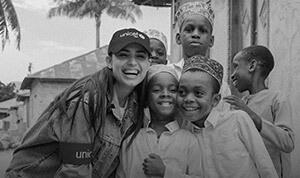
| UNICEF Ambassador Clay Aiken with children he met on his recent visit to Somalia. |
If you use an RSS reader, you can subscribe to a feed of all future entries tagged 'Clay Aiken'. [What is this?]
Welcome to Fieldnotes. Blogging gives us the ability to quickly report from the field, alert you to media coverage of interest, and share the success of UNICEF's lifesaving work around the globe.
We want to hear from you, so consider using the comment functionality to let us know what you think. Readers, please keep in mind that comments do not necessarily reflect official positions of UNICEF or the U.S. Fund for UNICEF. While we welcome multiple points of view here, we will review each comment prior to posting it and will not post comments that are off-topic or inappropriate for this public forum.
Frequent Contributors
Jen Banbury, Communication & Creative Services
Kristi Burnham, Community & Volunteer Partnerships
David Donaldson, Education
Mark Engman, Public Policy & Advocacy
Adam Fifield, Communication & Creative Services
Elizabeth Kiem, Interactive Marketing
Jenner Pascua, Interactive Marketing
Martin Rendón, Public Policy & Advocacy
Caryl M. Stern, President & CEO