New year, new beginnings. Brand new babies, too -- all around the world.
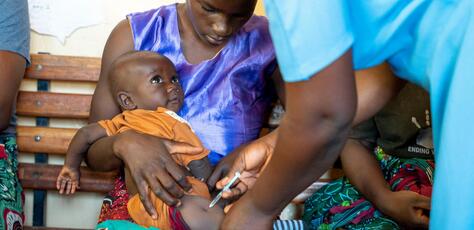
Here is a Hteik Hteik Soe, holding her eight-day-old son in Taung Pet Village in the eastern Shan State of Myanmar.
There's no way I can forget the date of the massive 2004 Indian Ocean tsunami: the tsunami struck December 26, which happens to be my birthday. The next day, my husband—who's also a journalist—was on a plane to Indonesia. And in the coming weeks, he would call me every day with vivid descriptions on the devastation. Bodies in trees. Boats somersaulted onto houses. Mile after mile of empty coastline where villages had washed forever out to sea.
|
| © UNICEF/NYHQ2004-0886/Shehzad Noorani |
| SRI LANKA, 2004: Minhaz Haque, 15, guides his bicycle through the mud of his neighborhood, destroyed by the tsunami. Many of Minhaz' friends went missing and his family's house was wiped out. |
It feels hard to believe, in some ways, that the tsunami was (exactly) four years ago. I didn't work for UNICEF back then. But since I've been here, I've learned an awful lot about UNICEF's response to the tsunami and I am constantly impressed by just how many children we've helped in the aftermath of the disaster. In the early post-tsunami days, UNICEF stepped in to protect orphans and children separated from family members; supplied clean safe water, basic sanitation, and nutrition to children and families who had lost everything; and began to (yes, even in those very early days) rehabilitate schools. UNICEF actually took a leadership role amongst humanitarian organizations on the scene, coordinating water, sanitation, education and child protection efforts to maximize the efficiency of the overall response. (This is something we do a lot in emergency situations.)
Something I've heard again and again from UNICEF staff who have spent a lot of time in the field: the truly tough work of emergency response often begins weeks and even months after the immediate emergency is over. This is partly because media attention has dwindled and the donations aren't coming in the way they once were. (Less money means stretched resources.) It's also the case because diseases such as cholera, malaria and dengue fever can get a nasty foothold amongst people who, in the wake of a disaster, find themselves without homes, proper sanitation, adequate nutrition or clean, safe drinking water.
|
| © UNICEF/HQ08-0323/Adam Dean |
| MYANMAR: A small boy washes his hair with soap in the cyclone-affected township of Kunyangon in the southern Yangon Division. |
These days, UNICEF is working harder than ever in Myanmar. Recently, we've been worried about possible outbreaks of dengue fever there. When Cyclone Nargis blasted across the Irrawaddy Delta in early May, it left behind the sort of destruction that makes an attractive breeding ground for the dengue-carrying Aedes mosquito. Stagnant pools of water that collect in debris—scattered pots and pans, tires, bottles, ruined boats, plastic tarps—are like five-star hotels for these mosquitoes.
Dengue fever is a miserable disease. My cousin was unlucky enough to get it when he lived in Thailand. It leaves you with a fever, severe headache, muscle and joint pain, a rash and, in some cases (my cousin's being one of them) hair loss. The extreme version of the disease, dengue hemorrhagic fever, can be fatal. Dengue hits children and the elderly especially hard. There is no vaccine. And bed nets don't help because, unlike malaria mosquitoes which feed at night, dengue mosquitoes prefer to take their meals in the daytime.
Did you happen to catch the New York Times interview this weekend with U.S. Fund for UNICEF President and CEO Caryl Stern? In the article, Stern discusses how UNICEF is the world's leading child survival authority, and notes how our access and influence enabled UNICEF to respond so quickly in the aftermath of Cyclone Nargis in Myanmar and the earthquake that hit Sichuan Province in China.
![]() |
| © David Forbes |
| Caryl M. Stern joined the United States Fund for Unicef in 2006 and became the president and chief executive in June 2007. |
It’s been nearly three months since monster storm Cyclone Nargis buffeted Myanmar, but the Southeast Asian nation is still reeling from the blow.
The cyclone affected 2.4 million people, damaging or demolishing hundreds of thousands of homes and thousands of schools. A recent report (PDF, 665K) released by the UN and the Association of Southeast Asian Nations (ASEAN) detailed the cyclone’s colossal devastation—including the destruction of 75 percent of health facilities in affected areas, and the flooding of 600,000 hectares of farmland—and the continuing hardships facing survivors.
Last week, UNICEF warned that 700,000 children in Myanmar are still in need of assistance.
Recently, I had a great conversation with Shanelle Hall, director of UNICEF's supply division. As if I didn't know it already, she really gave me a vivid sense of how many essential, lifesaving supplies UNICEF gets to children all over the globe, every day. In 2007, for example, we shipped enough educational kits to supply over 12 million children and 100,000 teachers. We procured 3.2 billion doses of vaccine, at a value of $617 million—that's enough for 40 percent of the world's children. But, as massive as these achievements are, we're always thinking about the children we haven't yet reached: children who don't have the tools they need to learn, or who are dying from a disease that 27 cents worth of vaccine could have prevented.
|
| © UNICEF/ HQ05-1695/Josh Estey |
| INDONESIA: A girl holds a UNICEF school kit bearing outside her new school in Banda Aceh, capital of Aceh Province. The school kit contains workbooks, pencils, pens, crayons, rulers and sharpeners. |
You may have gotten an email recently about becoming an online monthly donor. If you aren't on our email list, you can read about it here. Regularly scheduled giving—where you commit to an ongoing monthly, quarterly or yearly donation paid automatically through your credit card—is a godsend to us. It makes it easier to sustain those programs that kids around the world need so badly. Because there are always new babies to vaccinate, and there are always children who want and need to learn. Scheduled giving also saves us tons of money on fundraising, which means more money going straight to helping kids. And it means we're not sending you regular paper mailings, asking you to renew a pledge (this, of course, has the added bonus of saving trees).
![]() | |
Those fun, fashion-forward folks at Bravo TV have come up with a unique celebrity dress auction benefitting UNICEF. Right now, when you buy a dress at Bravo TV's online charity auction, you'll be helping UNICEF's relief efforts in Myanmar.
Imagine owning a dress that was worn by a celebrity on Bravo's "A-List Awards" show, which aired on June 12. The dresses were all designed by contestants on Bravo's hit show "Project Runway."
All proceeds from the auction will go to UNICEF's relief work in Myanmar. So you'll not only get a fashion original, you'll be helping save children's lives as well.
Go to http://bravo.auction.seenon.com to start bidding. But hurry! The auction ends on June 19.
![]() |
| © © UNICEF/HQ08-0563/Win Naing |
![]() |
| © © UNICEF/HQ08-0559/Win Naing |
If you use an RSS reader, you can subscribe to a feed of all future entries tagged 'Myanmar'. [What is this?]
Welcome to Fieldnotes. Blogging gives us the ability to quickly report from the field, alert you to media coverage of interest, and share the success of UNICEF's lifesaving work around the globe.
We want to hear from you, so consider using the comment functionality to let us know what you think. Readers, please keep in mind that comments do not necessarily reflect official positions of UNICEF or the U.S. Fund for UNICEF. While we welcome multiple points of view here, we will review each comment prior to posting it and will not post comments that are off-topic or inappropriate for this public forum.
Frequent Contributors
Jen Banbury, Communication & Creative Services
Kristi Burnham, Community & Volunteer Partnerships
David Donaldson, Education
Mark Engman, Public Policy & Advocacy
Adam Fifield, Communication & Creative Services
Elizabeth Kiem, Interactive Marketing
Jenner Pascua, Interactive Marketing
Martin Rendón, Public Policy & Advocacy
Caryl M. Stern, President & CEO