Fieldnotes: Blogging on UNICEF's child survival work in the field

Entries from Fieldnotes tagged with 'Somalia'

Clay Aiken: progress in Somalia

UNICEF Ambassador Clay Aiken originally wrote this blog post for The Huffington Post on December 29, 2009. Please consider making a donation today to support UNICEF's lifesaving work for children in Somalia.

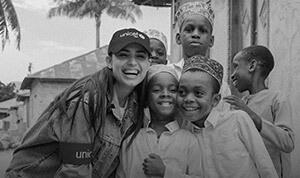
Clay Aiken on a recent field visit to Somolia.
© U.S. Fund for UNICEF
Clay Aiken on a recent field visit to Somolia.

This past November, while we celebrated the 20th anniversary of the signing of the Convention on the Rights of the Child, a grim milestone was reached in the east African nation of Somalia. The conflict and instability which has characterized that nation for the past 20 years has produced a generation in its central southern province that has never known peace.

In this season of peace and goodwill, this jarring reality should spur us to action so that future generations are not lost.

The mere mention of Somalia conjures in the mind of everyday Americans a place where lawlessness reigns. Indeed, the perception is that no other country has done more to place the issue of maritime piracy at the forefront of our minds and within our headlines.

While this may be true...it's certainly not the whole story.

Last year, in my role as UNICEF Ambassador, I spent five days in northwest Somalia. There's no question that years of civil war and a defunct central government has left much of this nation dangerously unstable. In fact, half the population of Somalia remains internally displaced and in a state of humanitarian emergency.

This tragic reality affects an estimated 3.6 million people, half of whom are children. Over 1.5 million are displaced as a result of conflict, largely between Islamic extremists and government forces. Not only is this population burdened by violence and instability, but also extreme poverty and recurrent food shortages.

There are, however, glimmers of hope. For one, the Somali Transitional Federal Government (TFG) has made overtures to place the well-being of children on its emerging social service agenda.

Malnutrition: a silent emergency

We've been reporting about the child malnutrition crisis quite a bit recently -- in places as varied as Somalia, Yemen and the Philippines.

It's a global crisis, but because it doesn't get much coverage in mainstream media, it's essentially a "silent emergency" for children.

Check out the new Every Child

Please check out the latest issue of Every Child, the U.S. Fund for UNICEF’s magazine. Featuring powerful photos and timely articles on child survival and other key issues, the publication offers a bird’s-eye view of UNICEF’s crucial work—and a look at supporters and partners like you who make that work possible. The cover story chronicles the efforts of UNICEF staff in conflict-ridden places like Somalia, where they often risk their own lives to save the lives of children. The feature spotlights UNICEF’s influential role in helping negotiate cease-fires in several war-torn countries so that children can get lifesaving health care.

Monday UNICEF pic: Somalia

Last week we reported that funding shortfalls could threaten humanitarian assistance activities that are so desperately needed in Somalia. One of UNICEF's key areas of concern is preventing and treating malnutrition in children, so I thought I'd share this photo taken at a UNICEF-supported nutrition program in Jamalaaye, a camp for displaced people in the north-western city of Berbera.

NewsNet: Don't forget about Somalia

I wrote about the deteriorating humanitarian emergency in Somalia—and how funding shortfalls were hampering UNICEF’s crucial work there—more than a year ago. In a March 15, 2008 Fieldnotes post, I cited a BBC story that quoted the country’s then UNICEF Representative, Christian Balslev-Olesen, calling Somalia’s plight the “forgotten crisis.”

Even though the suffering of Somalia’s people has only grown worse since then, much of the world continues to largely ignore it.

The vast majority of recent media coverage has focused on—you guessed it—pirates. Fighting between government forces and militants and concerns about the country becoming a terrorist safe haven have also generated considerable press. But little attention has been paid to the enormous human toll of Somalia’s woes. Read these articles from The Christian Science Monitor, Reuters, and Voice of America.

Humanitarian Action Report gives voice to silent emergencies

Every year, UNICEF releases a Humanitarian Action Report (known as HAR around here), which shines a spotlight on emergencies you may not even know about. You see, for every headline-grabbing emergency we respond to—like last spring's Sichuan Earthquake or the cyclone in Myanmar—there are dozens of lesser-known emergencies that are imperiling children and require strong, focused action from UNICEF and our partners.

HAR2a-IMG19570_Comp.jpg
© UNICEF/NYHQ2007-1416/Anita Khemka
In Afghanistan, the maternal mortality ratio (1,800 per 100,000 live births, based on 2005 estimates) is among the highest in the world. The mother of these children died during childbirth; now the siblings look after the baby.

These are often referred to as "silent emergencies" and they have been increasingly common of late. In fact, between 2005 and 2007, UNICEF responded annually to some 276 emergencies in 92 different countries. Over 50 percent of those emergencies were caused by disasters, 30 percent were caused by conflict, and health-related emergencies made up another 19 percent.

Malnutrition is deadlier than pirates

Most of the news coverage on Somalia lately has focused on those shockingly successful pirates who've been attacking ships and holding them for ransom off the country's coast. But for us here at UNICEF, the real Somalia story is happening on land, where kids and their families are suffering from the horrible side effects of a prolonged civil war.

som2a-IMG17741_Comp.jpg
© UNICEF/NYHQ2007-0051/Michael Kamber
SOMALIA: Boys attend class at a UNICEF-assisted school in Mogadishu, the capital.

For quite some time there's been vicious fighting between Somalia's government forces and Islamist insurgents who actually control parts of the country. As usual with conflicts like these, civilians have been hardest hit, as they're forced to flee the fighting and soon find themselves homeless, jobless and cut off from food and other resources.

Recently, neighboring Ethiopia has been withdrawing troops that were in Somalia to buoy the struggling Somali government. They provided a little stability and some argue that, once they're gone, fighting will get even worse.

Four years after THE tsunami

There's no way I can forget the date of the massive 2004 Indian Ocean tsunami: the tsunami struck December 26, which happens to be my birthday. The next day, my husband—who's also a journalist—was on a plane to Indonesia. And in the coming weeks, he would call me every day with vivid descriptions on the devastation. Bodies in trees. Boats somersaulted onto houses. Mile after mile of empty coastline where villages had washed forever out to sea.

indo4a-IMG12244_Comp.jpg
© UNICEF/NYHQ2004-0886/Shehzad Noorani
SRI LANKA, 2004: Minhaz Haque, 15, guides his bicycle through the mud of his neighborhood, destroyed by the tsunami. Many of Minhaz' friends went missing and his family's house was wiped out.

It feels hard to believe, in some ways, that the tsunami was (exactly) four years ago. I didn't work for UNICEF back then. But since I've been here, I've learned an awful lot about UNICEF's response to the tsunami and I am constantly impressed by just how many children we've helped in the aftermath of the disaster. In the early post-tsunami days, UNICEF stepped in to protect orphans and children separated from family members; supplied clean safe water, basic sanitation, and nutrition to children and families who had lost everything; and began to (yes, even in those very early days) rehabilitate schools. UNICEF actually took a leadership role amongst humanitarian organizations on the scene, coordinating water, sanitation, education and child protection efforts to maximize the efficiency of the overall response. (This is something we do a lot in emergency situations.)

Feed Subscription

If you use an RSS reader, you can subscribe to a feed of all future entries tagged 'Somalia'. [What is this?]

Subscribe to feed Subscribe to feed

Other Tags

Other tags used on this blog:

Subscribe to our blog

About this blog

Welcome to Fieldnotes. Blogging gives us the ability to quickly report from the field, alert you to media coverage of interest, and share the success of UNICEF's lifesaving work around the globe.

We want to hear from you, so consider using the comment functionality to let us know what you think. Readers, please keep in mind that comments do not necessarily reflect official positions of UNICEF or the U.S. Fund for UNICEF. While we welcome multiple points of view here, we will review each comment prior to posting it and will not post comments that are off-topic or inappropriate for this public forum.

Frequent Contributors

Jen Banbury, Communication & Creative Services

Kristi Burnham, Community & Volunteer Partnerships

David Donaldson, Education

Mark Engman, Public Policy & Advocacy

Adam Fifield, Communication & Creative Services

Elizabeth Kiem, Interactive Marketing

Jenner Pascua, Interactive Marketing

Martin Rendón, Public Policy & Advocacy

Caryl M. Stern, President & CEO