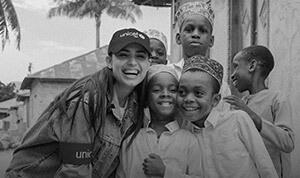
Amy Cedarburg is an international flight attendant and Champion for Children for UNICEF's Change for Good Program on American Airlines at Miami International Airport (IMA).
Someone once wisely said, "it takes a village to raise a child." Through the UNICEF field visit to Belize, I witnessed this first hand.
Our visit to the South Side of Belize City was exciting! We visited two schools to see the Child-Friendly School Initiative and an Adolescent Child- Friendly After School Center. At the first school, we were treated to a top notch band session. They had been together less than a year, and they could read music and played fantastically!
|
| © Amy Cedarburg for U.S. Fund for UNICEF/2010 |
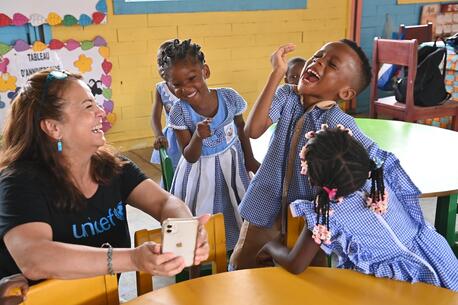
| Amy Cedarburg and student at St. Luke Methodist Primary School in Belize City, Belize. |
At the second school, the choir welcomed us with a heartwarming song, "Welcome to Belize", which brought tears to our eyes. Often, these children will arrive early and stay late at school. They were eager to show their learning prowess via their music, reading, writing and picture taking abilities.
At a UNICEF-supported After School Center we visited, children have a safe haven to learn new skills and get help with their homework. Adult activities have also been added to the curriculum, such as: baking and sewing classes for the women and lawn maintenance and gardening for the men. All around, it's a center for the whole community!
Through my humbling experience in Belize, I've realized that my small part, through the Change for Good program has had an everlasting effect in our world's village. It truly is and should be about the world's children!!
Proud to be a "Champion for Children" volunteer with UNICEF's Change for Good program on American Airlines.
From Ann Putnam Marks and Karen Turney in Panama. March 17, 2010
Our day began with a long drive to the "Comarca" (in Spanish it is an autonomous indigenous reserve) where many people from the Ngobe Bugle ethnic group live. We arrived at Nutrehogar, a nutrition center for malnourished children supported by UNICEF. We soon met a woman holding a limp, visibly malnourished child in her arms. The woman had walked a long distance in the heat to reach the center in search of help for the little girl, Betsy, who was clearly suffering. And although two years old, she appeared much younger. If her physical growth was this stunted, we can only imagine how much her learning potential had been affected, too. We learned Betsy was in such critical condition that Nutrehogar had arranged for her to be transported to a special medical center where she will be restored to good health and to her childhood and potential.
Nutrehogar provides critical nutritional intervention and early childhood development to children in need. Children in the Comarca are at greater risk for malnutrition, healthcare, and education, so Nutrehogar fulfills a critical gap for the youngest, most vulnerable children in this community. The center also trains mothers in the community about nutrition and how to care for and stimulate children from before their birth through age 5. Betsy and the other children we met there underscore the importance of UNICEF’s partnership with this NGO and our shared resolve to do whatever it takes to save a child.
|
| © U.S. Fund for UNICEF/2009 |
| A preschool in Calabazal, where UNICEF helped train the school teachers. |
Nutrehogar encourages the participation of mothers in the program. We had the opportunity to meet two mothers who volunteered to cook lunch that day. The menu consisted of rice, beans, and a very fresh iguana! Although not appealing to our palate, we were glad to see a nutritious, protein-rich meal for the children.
We also met a mother there who had been coming to Nutrehogar during her most recent two pregnancies. We met both little boys, eager to meet and play with us. Their mother was grateful for the center and mentioned what a great effect it had on her boys. The mother had not come to Nutrehogar when she had her two older girls and she could see a remarkable difference after coming to the center. Her boys, she said, were smarter, more curious, and healthier. For this woman and her children, Nutrehogar meant a better start and a better future.
We traveled next to another part of the Comarca, to the community of Calabazal. After a long walk down a steep tree-lined and sometimes treacherous path, we were welcomed to the Ngobe Bugle community’s pre-school. UNICEF helped train the school’s teachers, all of whom are mothers in the community. Despite the fact that the one-room thatched roof classroom has no electricity and mud floor, the community displayed an amazing enthusiasm for learning: we were even greeted by a father who serves as president of the PTA.
Last fall, David Donaldson, Director of Education at the U.S. Fund for UNICEF, and Kristi Burnham, Director of Volunteer and Community Partnerships, traveled to Kyrgyzstan for a field visit on Education Programs. Here is an excerpt of their recent presentation to the U.S. Fund staff on the need for funding in the region.
In this Central Asian country of over 5 million, where 98% of the population is literate and has access to television, UNICEF is developing innovative ways to reach populations affected by a depressed economy, poverty and a primarily agrarian society.
|
|
| © Donaldson for U.S. Fund for UNICEF/2009 |
| Children attending an Early Child Development Center that uses the pre-school shift model in the remote regions of Kyrgyzstan. |
UNICEF's role is to address children’s rights, work with Parliament on the adoption and development of the Code of the Kyrgyz Republic on Children and the inclusion of social protection in its curriculum, while helping to implement policies and political programs. Specific to education, UNICEF is working to make schools more child-friendly, by providing teacher trainings, creating community-based projects, and providing education.
Currently 12% of children in Kyrgyzstan attend preschool, while in rural areas only 4% have access to preschools.
UNICEF Kyrgyzstan and its partners have been implementing a shift model for preschool institutions based on duration rather than intensity of attendance (period in preschool in years, vs hours per day in class) and has also proposed to the Government to make this gradual transition.
This model reaches double the number of children, especially the most poor and vulnerable. It is also much cheaper, as children do not sleep in preschools and attend not for 9 hours, as has been usual practice in the country, but rather for just a few hours. This simplifies maintenance and preserves the educational component.
Casey Rotter is a development officer at the U.S. Fund for UNICEF. On Saturday, February 13, she leaves for a week-long field trip to Guatemala with members of UNICEF's Next Generation.
Elizabeth Merola recently visited UNICEF programs in Zambia. In this post, she recounts the experience of visiting a rural health clinic.
The drive to Keemba Rural Health Clinic from the closest town is a long and bumpy ride due to the uneven dirt roads. Looking out the window I see children walking to and from school alongside the road and across fields that are being prepared for the first rains of the season. Cows are crazing and ox carts are transporting people from one village to the next.
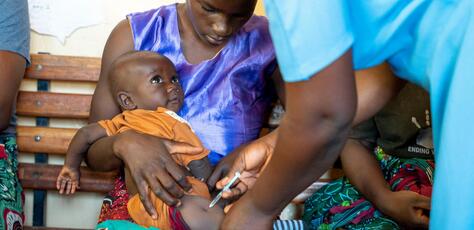
When we arrive at the clinic, mothers with their children are waiting for post-natal and prevention of mother-to-child treatment (PMTCT) care. The nurses dressed in white stand out among the women with colorful wraps.
I am immediately drawn to Brenda who is 7 months old and attached to the back of her mother, Rolina. Rolina waits patiently in line for her turn to speak with the nurse. Her calmness gives me the impression that there is no urgency for her visit and she has been in this position many times before.
|
| © U.S. Fund for UNICEF/2009 |
| Rolina and Terrance with daughter Brenda. |
Rolina is HIV positive and is enrolled in the clinic’s PMTCT program. She and her husband Terrance married in 2002 and they have three children; Terrance is also HIV positive. Both Rolina and Terrance are doing everything in their power to ensure that little Brenda stays safe and healthy which is not the case for Brenda’s older sister Constance. Constance is 4 years old and HIV positive. Constance is on pediatric treatment which is keeping her strong. Their older brother Clayton does what he can at 7 years old to look after his two younger sisters.
The past decade in Tanzania has been marked by successful reforms, steady economic growth, and political stability. Despite this progress, Tanzania’s challenge for the future is to create better living conditions for the rural poor, control the spread of HIV/AIDS, address the needs of the largest refugee population in Africa (due to neighboring conflicts), and through education develop the next generation of leaders. Sonya Renner was part of a U.S. Fund delegation from Texas and Georgia and witnessed firsthand how UNICEF impacts the lives of Tanzania’s children, and through them, Tanzania’s future.
Is it a childhood luxury to be able to attend primary school? Are dreams for the future a privilege for a limited few? While the American public education system and its schools face challenges, particularly now, we have an advantage that many countries don’t have: a long and deep-rooted belief that quality education is a right for all children. We work to insure that education is free and compulsory. We teach our children that they can—and should—dream of a future.
|
| © U.S. Fund for UNICEF/Renner/2009 |
| Students at a school not in the child friendly school pilot program talked of their need for more classrooms, windows, floors, desks, books, paper, and pencils. |
UNICEF believes that every child around the world has an equal right to education and should dream of a better future. This can become a reality for more children through UNICEF’s child friendly school model, which focuses not just on academic skills but also teaches basic life skills—lifesaving skills—such as hand-washing, hygiene, and preventing the spread and impact of HIV/AIDS. The child friendly school program then can have a major role in achieving zero child deaths from preventable causes.
Jennifer Dorian, member of the U.S. Fund for UNICEF’s volunteer Marketing Committee and a true friend of children, visited UNICEF programs in Guatemala this week and sent this post from the field.
Growing up, my favorite movie was Norma Rae.
I loved the character--the way she stayed a welcome member of her community without suppressing her natural leadership. She was unstoppable despite her odds and humble beginnings. She led her mill town to a better life with charisma, strong opinions and courage.
|
| © Dorian/2009 |
| A real-life Norma Rae: Jennifer Dorian with Marileni. |
Today I met a real-life Norma Rae in Nuevo Concepcion, Guatemala. She is young (21), childless (by choice), charming and beautiful. Her name is Marileni.
Kendra Flowers works with the U.S. Fund for UNICEF at our national headquarters in New York City. She's currently in Peru visiting UNICEF programs.
I'd like to begin this entry by sending wishes of support to those presently suffering in the aftermath of Pakistan's recent earthquake. Having just left the devastation of Pisco and Chincha—still recovering from their own devastating earthquake of over a year ago—I am somber, yet so glad to know that UNICEF is working tirelessly in Pakistan to ease the suffering of children and get aid to those in need.
After Tuesday's seven-hour drive through the beautiful Andes, and a little light-headedness at over 12,000 feet, the lights of Ayacucho in the valley below were a welcome sight. Wednesday morning we journeyed over an hour back into the Andes to the indigenous communities of Rosaspata, Arizona, Chullucapampa and Huamanguilla.
There we learned directly from the community leaders and parents all about their early childhood stimulation programs and child health surveillance centers. Early childhood stimulation practices the concept that children fare far better socially, physically, and intellectually when they're sung to, played with, and engaged in activities as infants and toddlers. Surveillance centers are posts where child growth is measured and local health promoters are trained in an effort to combat chronic malnutrition in indigenous communities.
![]() |
| © US Fund for UNICEF/K. Flowers |
| UNICEF-trained heath promoter in Rosaspata community of Ayacucho District, Peru. |
We were all struck by how utterly committed these communities are to their children's physical and emotional health. The president of one community program was so impassioned when he proudly explained their meticulous charts and graphs that one needn't have any knowledge of Quechua (the native tongue) to know his community's priorities revolve around its children. UNICEF trains health promoters within the community to monitor families and ensure they are educated in how to nourish and protect their children. The promoters report back to the center with height, weight and other general health measurements revisiting the children's progress each and every month.
If you use an RSS reader, you can subscribe to a feed of all future entries tagged 'field visit'. [What is this?]
Welcome to Fieldnotes. Blogging gives us the ability to quickly report from the field, alert you to media coverage of interest, and share the success of UNICEF's lifesaving work around the globe.
We want to hear from you, so consider using the comment functionality to let us know what you think. Readers, please keep in mind that comments do not necessarily reflect official positions of UNICEF or the U.S. Fund for UNICEF. While we welcome multiple points of view here, we will review each comment prior to posting it and will not post comments that are off-topic or inappropriate for this public forum.
Frequent Contributors
Jen Banbury, Communication & Creative Services
Kristi Burnham, Community & Volunteer Partnerships
David Donaldson, Education
Mark Engman, Public Policy & Advocacy
Adam Fifield, Communication & Creative Services
Elizabeth Kiem, Interactive Marketing
Jenner Pascua, Interactive Marketing
Martin Rendón, Public Policy & Advocacy
Caryl M. Stern, President & CEO